
Three of Swords
Painful, honest heartbreak. Sorrow and grief that come with a hard truth.
- Heartbreak
- Sorrow
- Grief
- Painful truth
- Recovery
- Forgiveness
- Releasing pain
Context & Overall energy
Open any card to read its upright meaning, reversed meaning, keywords, and related cards.
- Context: Three swords pierce a red heart beneath heavy gray clouds and a steady fall of rain. The Three of Swords does not disguise pain; it places a hurtful truth where it can be acknowledged instead of continuing to shape life from concealment.
- Overall energy: The heart is the vulnerable emotional center, while the blades suggest words, realizations, or separations that have found the sorest place. Rain gives grief its own weather, yet weather moves through a sky rather than becoming the sky forever.
Detailed upright interpretation & Detailed reversed interpretation
Painful, honest heartbreak. Sorrow and grief that come with a hard truth.
Upright meaning
- Heartbreak
- Sorrow
- Grief
- Painful truth
Painful, honest heartbreak. Sorrow and grief that come with a hard truth.
Upright, the Three of Swords carries heartbreak, sorrow, grief, and a painful truth. It does not ask you to recover on schedule; it asks you to name what happened so pain does not have to hide inside anger or self-blame.
Reversed meaning
- Recovery
- Forgiveness
- Releasing pain
Beginning to heal. Recovery, forgiveness, and releasing pain that's been held onto too long.
Reversed, recovery, forgiveness, and the release of long-held pain begin to find room. The wound may still be present, but it no longer has to define every new encounter or every story you tell about yourself.
Meaning in life areas
Open any card to read its upright meaning, reversed meaning, keywords, and related cards.
| Life area | ↑ Upright | ↓ Reversed |
|---|---|---|
| Love and relationships | ↑ UprightIn love, the Three may reflect separation, injuring words, or the moment an idealized picture can no longer survive. Be honest about the hurt and any necessary boundary rather than performing normality to avoid disturbing the relationship. | ↓ ReversedThe sharpest pain has passed and the recovery is underway, or grief is being held onto because letting it go feels like agreeing the hurt did not matter. Reversed, it mattered, and you can still put it down. |
| Work and career | ↑ UprightAt work, difficult feedback, a failed collaboration, or a disappointing outcome may cut deeper than it first appears. Separate your worth from the event, then decide what needs correction, mourning, or a clear ending. | ↓ ReversedA professional wound is being carried into new situations. Reversed, the caution it produced was earned; applying it to people who did nothing is where it costs you. |
| Money and resources | ↑ UprightWith money, a loss or unwelcome fact may create an urge to act only to escape the feeling. First assess the impact, the immediate need, and what remains within your control instead of allowing regret to speak for the whole present. | ↓ ReversedA painful financial event is still shaping decisions long after the event. Reversed, recognise which rules you made in the aftermath and check whether they still serve you. |
| Health and well-being | ↑ UprightFor emotional well-being, grief can consume energy and narrow the world even while you continue to function outwardly. Giving it a name, a protected time, and a trustworthy witness allows the feeling to move rather than harden. | ↓ ReversedEmotional pain is easing but the body has not caught up yet. Reversed, this lag between feeling better and being better is normal, and it does not mean the recovery has stalled. |
| Yes or no | ↑ UprightNoThis leans no because an unacknowledged hurt or painful truth sits beneath the question, making forward movement likely to repeat the wound. | ↓ ReversedIt dependsThe worst of this is behind you and the caution it left has not updated yet. It leans yes once the fear is separated from the memory. |
Guidance
↑ Upright
Name what was lost or what caused harm without enlarging it into a verdict on your future. Keep the boundary you need, let grief be real, and wait until the feeling has room before demanding meaning from it.
↓ Reversed
Say what the hurt taught you, then say what it is no longer entitled to decide. Both sentences are true and only the first one usually gets spoken.
Related cards


Card pairings
- The Star
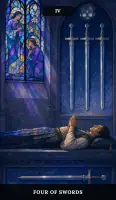
The Star brings hope into the Three's pain, making a difficult truth the beginning of honest renewal rather than the final word.
- Five of Cups
The Five of Cups deepens the experience of loss while reminding you that what remains becomes visible after grief is honored.
Frequently asked questions
What truth does the Three of Swords ask me to face inside the pain?
Ask what actually happened, what you hoped would happen, and where those two realities separated. Naming that gap gives grief a shape instead of letting it spread into the belief that everything is wrong.
Does the Three of Swords reversed mean forgiveness is complete?
Not necessarily, since forgiveness can unfold in layers rather than through a single decision. A more useful sign is that the injury has less power over how you view yourself, other people, and the future.
How do I keep the Three of Swords from becoming self-blame?
Distinguish specific responsibility from the belief that your whole character is at fault. You can own your part, repair what is possible, and refuse to carry responsibility that belongs elsewhere.